Thursday, February 28, 2013

Once again, too long a time has lapsed since I last posted. That time was taken up by Christmas--and very welcome visits home from all of our (now grown) children. Immediately afterward, we had to rush to get our big Christmastime fundraising exhibit, the Festival of Trees, taken down so that we could begin to hang the sampler exhibit.
The samplers had been in our dark storage room, awaiting the big moment. On shelves, it was easy to lose track of just how large a collection 114 samplers really is. It took us--me, our new museum director Tara Raiselis, Collections Manager Camille Smalley and Education Manager Anna Kelly, about three hours just to carry them all up, one at a time, and position them around the big rear gallery of the museum. Our initial plan was to not install any of our portable walls, as we thought they might interrupt the "flow" of the exhibit--and because they are NOT at all portable. (New, really portable walls are on our wish list!)
It quickly became very clear that, even though the rear gallery is very large, we would have to hang the samplers one above another, three inches apart, all the way around the room, without the portable walls. That would mean that people would not be able to get a good close look at the stitchery because it would either be too high or too low. And where would we put the object labels?
Out came the portable walls--all of them. With all that additional wall space, what we ended up with is the samplers hung about six inches apart, all the way around the room, and three or four of the smaller ones hung one above another--and then they all fit. It looks so wonderful.
One of the more moving moments for me (and there were many) was when I hung the samplers of Sarah Jane and Julia Ann Patch next to each other. These two young women were first cousins who were born and raised in what was once and still remains a very small town: Otisfield, Maine, located over in the foothills of the White Mountains. Sarah Jane (1819-1847) and Julia Ann (1807-1848) died within a few months of each other, and are buried within ten feet of each other in a small, sunny cemetery that slopes down away from the road in Otisfield. I imagine Julia Ann watching over her younger cousin when they were children, and how Sarah Jane must have looked up to her as a role model. Perhaps this is a romanticized view of the two girls, but it doesn't seem like too much of a stretch for me. Neither ever married. Julia Ann's sampler belongs to the Otisfield Historical Society; it has never traveled far from home, since it was discovered not too many years ago in a trunk in the attic of her father's still-standing home. Sarah Jane's work traveled a different, more uncertain (at least for me) route, being purchased at auction several years ago by someone who lives in the Williamsburg, Virginia area.
When I hung the samplers side by side on the wall, I had to wonder when the last time these two pieces had been near each other. It was an amazing moment!


The Last Days of the Exhibit; A New find
The exhibit at the Saco Museum, "I My Needle Ply with Skill" runs for only two more days after today. After all the hard work, it's pretty sad to see it ending. Attendance has been very strong, especially given the time of year and the fact that we are in Maine. And that we've had a few snowstorms to compete with, as well.
If you have followed this (sadly negelcted) blog then you know that one of the outcomes of my research was to identify a very large--from my point of view--group of related Portland, Maine samplers. Yesterday, a friend brought me an unexpected gift, a copy of the book Samplers by Rebecca Scott who seems to be an antiques dealer in England. The last chapter of the book deals with American samplers and it includes a photograph of the sampler of Eliza Manley, completed in 1808, and yet another one for "my group" that I have, so far, attributed to the academy of Rachel Hall Neal.
Eliza Manley seems to have been the daughter of Daniel Manley, probably born in 1774 in Easton, Massachusetts. He married Catharine Fergeson and they were the parents of two children born in Easthampton, Massachusetts, Eliza on June 22, 1797. By the early 1800s, Daniel had relocated to Portland and Catharine had apparently died. [A quick observation here is that Easton is in far eastern Massachusetts, Easthampton is in western Massachusetts--not especially close by, and then we have Daniel appearing in Portland. Given his unsavory later history, perhaps he was a man who needed to get out of town--FAR out of town--frequently.] He married second Mehitable, and Portland vital records lists the birth of three more children with her before she died at age 35 in 1818. On September 2, 1816, Eliza Manley married George M. Gilliard of Eastport, Maine. She had given birth to two children by the time of her early death July 23, 1820. One of the interesting little tidbits that I discovered is that when her father died in 1837 in Portland the epitaph carved onto his gravestone read, "Portland's first bank robber"!
That sounded intriguing. Google being what it is, naturally I was able to get the backstory on Daniel with very few clicks. If you visit this link, you can read the tale, as well: strangemaine.blogspot.com/2006/06/portlands-first-bank-robber.html
Assuming that the blog is correct, it also provides some information about Daniel's employment: that he ran a small, bottom end store near the water. It seems that the men that sent their daughters to this female academy weren't always of the wealthiest sort. They were nearly always living in Portland, so Mrs. Neal perhaps didn't board her scholars but offered instruction to day students--a cheaper prospect for their parents.

Like most other samplers in the group, especially those made before 1817, Eliza's has a queen stitch border, her name is boldly spelled out, she includes the precise date of completion, and names Portland. About a third of the group have a cross stitch scene near the bottom. In almost every case where there is a scene, it features a three-storey house, a fence, and a pastoral scene. All of the samplers also include either one or two floral sprigs near the girl's name, and even after the teacher began having her students work the border in satin stitch, the sprig(s) always were done in queen stitch.
I had hoped to find a connection between Eliza and some of the other girls, or with Rachel, but I was not able to--not that that is especially surprising.
So I am back in the writing and researching mode and hopefully will be--now that I have somehow managed to fix a technical difficulty I was having with this blog and photos--writing lots more.
Don't forget that the book I My Needle Ply with Skill is available for sale on the Saco Museum website : www.sacomuseum.org
Friday, December 7, 2012
Although I am a "mature" woman, I vividly remember giving birth (x5!). Getting the catalogue for our coming exhibition out the door to the printer, a goal still not yet achieved, is turning out to be a very similar experience, only far more protracted. Every time I *think* everything is pretty much set to go, there's another fly in the ointment...
Here are a few of the things that have been involved, and several of the pitfalls. The first thing--which goes back to a beginning, a couple of years ago--was locating and deciding on the samplers that would be included in the exhibit (and catalogue). My goal, however lofty, was to try to track down as many examples as possible of needlework styles from all across the state of Maine, but ones that were disctinctive enough to constitute separate bodies of work from particular teachers or academies. A high percentage of basic marking samplers just don't make that cut. They are lovely, but lack the ornamental elements that make a group distinctive. Not surprisingly, even when I found unique works that would help define groups, the owners were not always willing to loan. That has proven to be one of the most major of pitfalls. I had, for example, through the kindness of the collector, located a substantial group of first rate Maine pieces, several of which seemed to me to be of critical importance to the exhibit, if we were to meet the goal. In the end, the collector decided not to loan them. Ouch.
The second thing involved was to get good photographs of the works that would be in the catalogue. Prior to beginning this eneterprise, I had heard of dpi, but it meant little or nothing to me. Now it haunts my nightmares. The photos HAVE to be 300 dpi, (dots per inch) or they will look like murky messes on the printed page. Collecting the photos turned out to be another difficult problem. I needed them in order to get the pages set up. Sometimes it was very near impossible to get the photos in a timely fashion. I, in my innocence and--greater issue--ignorance, believed that I should set a goal of getting either the needlework here so we could have the photographs taken OR the photographs taken by the owners and sent to me, by mid-November. Stupid. These were two entirely different aspects of the project and the timeframe for them should also have been different. It would have been far wiser to aim for getting the photos of samplers owned by institutions last summer; then if there were delays, as there almost always are, I would have had plenty of time.
A secondary photography issue was that I wanted to include the photos of those wonderous pieces that were not going to be loaned, which I had taken photos of last winter=for research purposes--never intending them to be included in a catalogue. Those samplers ought to have been rephotographed by a professional, but a combination of factors eventually made that impossible. Worrying over that whole issue was really awful and it ending up coming down to the wire, making final formatting impossible until very late in the game.
The third thing was the writing. I write a lot. I like to write. I loved doing the research for the 125 or so bios of the sampler makers and perhaps another 20 or 30 of their teachers. In fact, now that all of the research is done, I'm experiencing some sad kind of withdrawal pains. But all of that took an enormous amount of time, and sadly, right in the midst of it, two key staff members left. That meant that a) they were no longer here to help with the bio research, b) time had to be spent finding replacement people, and c) I and one other remaining museum staff person had to try to do their work, in addition to our own.
Writing, Part B, involved that nasty business of editing, for which I confess to having only an average eye, or ability. As the issues, above, mounted, I found it harder and harder to sleep at night. Partly it was because I was working very late many nights; if I wasn't working late, I was fretting late (almost as much fun, right?) The less sleep I got, the worse I became at spotting the missing commas. One of the former staff people very kindly donated her time to edit the thing--no small feat--and sent all of her changes, neatly encapsulated within that Track Changes feature of Word. I think, somehow, that in accepting the changes, I "lost" a LOT of them, and then, unknowingly sent it back off to the designer still really needing an edit. That meant, when it came back again, for a final quick loo(!), it was still in need of a lot of attention.
I have signed a contract with virtualbookworm.com Publishing, who are very nice to work with so far, and the only on-demand publisher I could find that used 60 lb. paper, but I still don't have a book in their hands to print and the exhibit is really only a bit more than a month away right now. Egads! In a couple of days,when the manuscript is finally off to them--I HOPE!--I will write again about new sampler discoveries, which is a lot more fun for readers than my whining.
Monday, October 29, 2012
More than a month has gone by since my last post. This is a reflection of just how busy I have been preparing for the coming exhibit, rather than a show of a lack of interest. It's amazing how many "moving parts" all have to come together to get about 115 pieces of needlework here from all over the country, get bios written for all those embroiderers and for as many of their teachers as I can identify, AND make arrangements for the photography that has to happen for the publication. Another time-consuming element has been shopping between various on-demand publishers, trying to identify the best deal, and now, the final editing of all the publication materials. I did discover that, while the publication will be available for purchase on Amazon.com., it will be much more financially satisfactory (read that as we will make more money) if we can primarily sell them on-site. Amazon is an expensive but highly necessary piece to selling our publication. But any profits from the book are going to help us defray the costs of the exhibit. I didn't expect such a large difference between Amazon sales and gift shop sales.
Since last I wrote, I have had the opportunity to visit and borrow needlework from the Pejepscot Historical Society in Brunswick, Maine and the Lincoln County Historical Society in Wiscasset, Maine, both coastal communities "downeast" of Portland. I knew I was borrowing from Pejepscot a sampler that was made, (according to the very early label on the back written by the sampler maker's daughter,) at Miss Hall's Infant School in Portland. Tracking down Miss Hall has so far eluded me. There was Martha Hall that appeared on the 1830 census as a head of household in Portland. A clue? Maybe, or maybe not. There were several male Hall heads of household in Portland that year, as well, and Miss Hall may have been the daughter of any of them.
But I came away from the Pejepscot's museum with a fabulous (totally unexpected!) example stitched by Frances Niles, probably made in Topsham, Maine. She had to add her name and verse sideways when she ran out of room on her meticulously stitched sampler. Or maybe she planned it that way all along? It doesn't match with any others I've seen so far. For another (unrelated) example of sideways stitching, see below.
Another recent and exciting discovery is of a sampler owned by Strawbery Banke, and being loaned for the exhibit. We were already borrowing a sampler owned by the Wells Public Library, which was the only one of its style I had seen. It turns out that there is ample evidence that the Strawbery Banke piece was stitched under the instruction of the same teacher.

The most important thing to come to light in the last month, however, was that we were notified by the Coby Foundation, Ltd., of New York City that we would be receiving a grant of $18,000 in support of the exhibit and publication. That piece of news made me cry. The Saco Museum is not a large place. Between the Dyer Library and Saco Museum--both run by the non-profit Dyer Library Association--we have a staff of twenty. Most of those work at the library. The museum has only two full-time staff members. This exhibit would have gone forward, no matter whether we received any grant to support for it or not, but having the backing of the prestigious Coby Foundation not only seems like recognition for the hard, in depth work we are doing, but also means that we can do a better job.
Here is what the Coby Foundation says about itself on the website:

Since last I wrote, I have had the opportunity to visit and borrow needlework from the Pejepscot Historical Society in Brunswick, Maine and the Lincoln County Historical Society in Wiscasset, Maine, both coastal communities "downeast" of Portland. I knew I was borrowing from Pejepscot a sampler that was made, (according to the very early label on the back written by the sampler maker's daughter,) at Miss Hall's Infant School in Portland. Tracking down Miss Hall has so far eluded me. There was Martha Hall that appeared on the 1830 census as a head of household in Portland. A clue? Maybe, or maybe not. There were several male Hall heads of household in Portland that year, as well, and Miss Hall may have been the daughter of any of them.
But I came away from the Pejepscot's museum with a fabulous (totally unexpected!) example stitched by Frances Niles, probably made in Topsham, Maine. She had to add her name and verse sideways when she ran out of room on her meticulously stitched sampler. Or maybe she planned it that way all along? It doesn't match with any others I've seen so far. For another (unrelated) example of sideways stitching, see below.
Another recent and exciting discovery is of a sampler owned by Strawbery Banke, and being loaned for the exhibit. We were already borrowing a sampler owned by the Wells Public Library, which was the only one of its style I had seen. It turns out that there is ample evidence that the Strawbery Banke piece was stitched under the instruction of the same teacher.


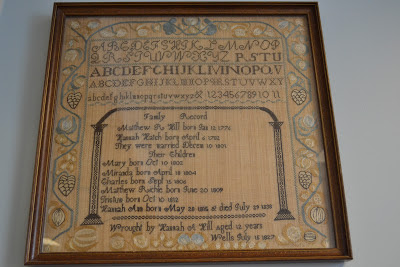
The upper one is from the Wells Public Library. Take a look at the alphabets on both and the use of the black narrow border seen at the bottom of the upper sampler and throughout the second one. They are both spectacular and document an issue (question?) that I have previously reffered to when discussing Portland samplers. How similar do two peices have to be to attribute them to the same school? In Portland, that is a complicated question because there were many teachers with very closely related styles. Wells is a much smaller place; to date I have found no advertisements for female academies there, but these two works have enough features in common to make it highly likely that the same still-anonymous instructor taught both girls.The most important thing to come to light in the last month, however, was that we were notified by the Coby Foundation, Ltd., of New York City that we would be receiving a grant of $18,000 in support of the exhibit and publication. That piece of news made me cry. The Saco Museum is not a large place. Between the Dyer Library and Saco Museum--both run by the non-profit Dyer Library Association--we have a staff of twenty. Most of those work at the library. The museum has only two full-time staff members. This exhibit would have gone forward, no matter whether we received any grant to support for it or not, but having the backing of the prestigious Coby Foundation not only seems like recognition for the hard, in depth work we are doing, but also means that we can do a better job.
Here is what the Coby Foundation says about itself on the website:
The Coby Foundation, Ltd., located in New York City, funds projects in the textile and needle arts field. Its funding is limited to non-profit organizations in the Mid-Atlantic and New England.
The Coby Foundation was established in 1994 by Irene Zambelli Silverman in honor of her mother, Irene Meladakis Zambelli. Mrs. Silverman described her mother as "the finest needlewoman in New York."
The majority of the Coby Foundation's support goes to exhibitions and education programs that combine excellent scholarship and effective interpretation. Projects may be in the arts or humanities, contemporary or historical, but all must have a public benefit. Such projects may include research and documentation, conservation, publication and Web projects. The Foundation supports only the direct costs of projects.
We are very grateful to Lynne Anderson for telling us about the foundation's work. We are thrilled to receive a grant from the Coby Foundation.
Wednesday, September 19, 2012
With some helpful advice and sampler searching from Lynne
Anderson, the head of the Sampler Consortium project—more about that in a bit—I
have put together another small group of related samplers, this time from well
up the state of Maine, and inland.


I
said that there is a group of related pieces, so here are the rest. The first
made by Elizabeth Freeman in Norridgewock in 1820, is owned by Historic New
England and is being loaned for the exhibit.

This
one is owned by Maine State Museum, was made by Susan Crosby in Norridgewock in
1822, and sadly, can’t be loaned as it has recently been exhibited quite a lot.
My version of this one is very poor. Try visiting the Maine State Museum website for a better image. www.mainestatemuseum.com


While
none of these are nearly identical to each other as some of the other sampler
groups I’ve shown you are, there are common features that some share, with
enough overlap to make a group attribution. Note the interesting deeply arcaded
border that some of them have. That is a common stylistic element of Essex
County, Massachusetts samplers. I’d love to say that Lyman had her schooling in
Essex County, but Northbridge, her home, is not in or near Essex County.
However, for what it’s worth, many of her immediate ancestors were from northeastern
Massachusetts so she may have been
exposed to that influence.
And
remember how I mentioned the Sampler Consortium? That is a grant funded project
to discover and thoroughly document American samplers, their makers and the
teachers behind those wonderful works.
Wednesday, September 12, 2012
More About the Mystery...
I just had a nice email today back from Laura Fecych Sprague who must be the expert on the Misses Martins' School for Young Ladies, which was surely regarded as the premier school for young women in Portland in the Federal era. My primary question to her was regarding the list of students that attended the school. As I have previously mentioned, the list is "believed to be incomplete"; the issue for me is how incomplete? While she noted that even the omission of 10% of the girls would result in more than 50 missing names, she agreed that finding fully 15 samplers made by girls whose names don't match up with the list is certainly beginning to constitute good evicence that the samplers did not originate there.
The other question that we have exchanged emails on is whether or not samplers (not just these, but any samplers) were even made at Misses Martins. Again, considering the vast number of known students and the near total failure to date in my research of discovering a body of sampler work associated with the school, that is beginning to look rather like a likelihood.
That raises an inteersting idea. How many times have I said that??? Might Portland girls have attended smaller, less famous schools initially to acquire the simpler skills a well-turned-out young woman ought to possess--plain sewing, marking skills, introductory academics--and then gone on to Misses Martins (money permitting) to learn the higher level arts: painting (which we know was done there,) the fancier embroidery of mourning pieces, perhaps elaborate calligraphy, and more advanced academic work? If so, that would tend to imply that the average age for Misses Martins' students would be a little older than for the other academies? Certainly, the 15 related samplers I have identified, the average age is not particularly young: they run from ten to eighteen but are concentrated in the eleven to thirteen-year-old range.
For an eighteen-year-old (one of the earliest dates of creation, also) this school must surely have been the last she attended. For the others, further education would have been a real possibility, especially taking into consideration that the length of time a girl attended a school was quite often just a year or less. I must begin to wonder how much "cross-pollination" was going on. How often did girls attend more than one Portland academy? Or sisters attend different academies? I don't think that we can draw easy conclusions that since a particular work by one girl is documented to a certain school, that not especially similar works by her sisters can therefore also be attributed to the same school.
Portland, by today's standards, was only a large town in the Federal era, not a thriving metropolis. Parents would have had familiarity with all the schools, all the teachers and with the daughters of friends and connections who had been pupils in a variety of places. Even given a loyalty factor, it's probably safe to assume quite a lot of switching around!
Subscribe to:
Posts (Atom)